
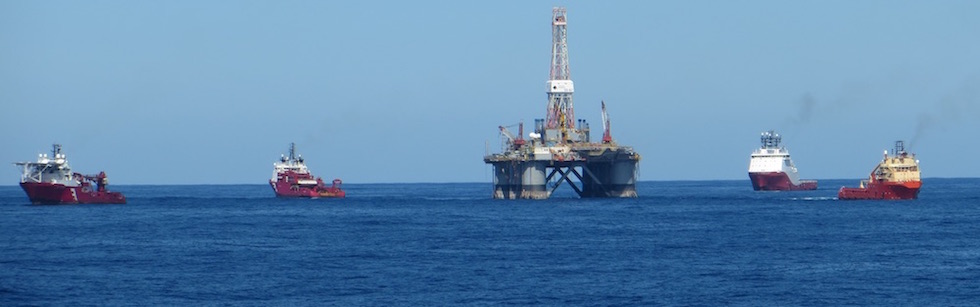

THE TRISTAN JANICE AND A GAS PLATFORM
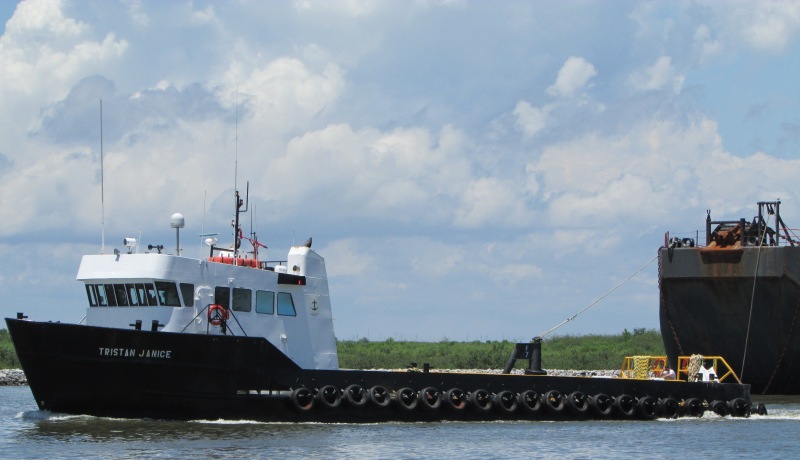
The Tristan Janice from Shipspotting
Every now and again investigators report on an incident which contains almost all the ingredients which ship operators would, one thinks, be trying to avoid. This is the case of the Tristan Janice a very small supply vessel which collided (the report uses the word allided but it’s not in my Oxford Dictionary) with a small gas platform quite close to the coast of Louisiana. And since no-one was injured in any way we can learn the lesson and smile a bit at the misfortune of others.
The Tristan Janice was a 100 foot platform supply ship, crewed by two deck officers and two seamen. Both the deck officers were qualified masters.
On February 17th 2014 at 2345 the ship left Golden Meadow and headed downriver with the mate in charge. The captain had mentioned to the mate that he felt that the starboard engine throttle had an air leak. The ship had been instructed by the owners, TRTB, to linger at Port Fourchon before continuing to sea at 0600.
However when the captain arrived on the bridge shortly after 0615 he found that rather than being in Fourchon the ship was at sea, proceeding at full ahead at almost 10 knots, in thick fog, and there was no-one on the bridge. He looked round to see the mate on the afterdeck, and on approaching him was told that he had been checking possible engine vibration. The two officers then went to the bridge where they discussed a number of items, but not the fact that the mate had instructed the seaman on watch with him to tie off the starboard engine throttle to keep up full speed, or the possibility of setting a lookout in the fog.
The mate left the bridge at about 0700 but a few minutes later returned and the two discussed traffic in the area. Later the captain said that he had reduced speed, but the AIS data indicates that this did not happen, and in any case he was unaware that he had no control over the starboard engine.
At 0712 the captain looked up from the radar to see a gas platform close ahead. He attempted to slow down with no success and tried to alter course but found that he could not disengage the autopilot, and the ship hit the platform at full speed. Thereafter the deck hands entered the engine room and untied the string from the throttle. Then without reporting the accident to the authorities the ship started off in a westnorthwesterly direction towards the coast.
And to make matters worse the master designated by the company as captain claimed not to be the captain at all. The investigators said that in addition to the lack of certainly as to who was in charge, there were no records of the ship’s progress, so collectively it was determined that the ship was proceeding at full speed, without a lookout or proper control, in restricted visibility, with no record of where it was and no identified person in charge. Oh dear!
THE DD1001 DESTROYER
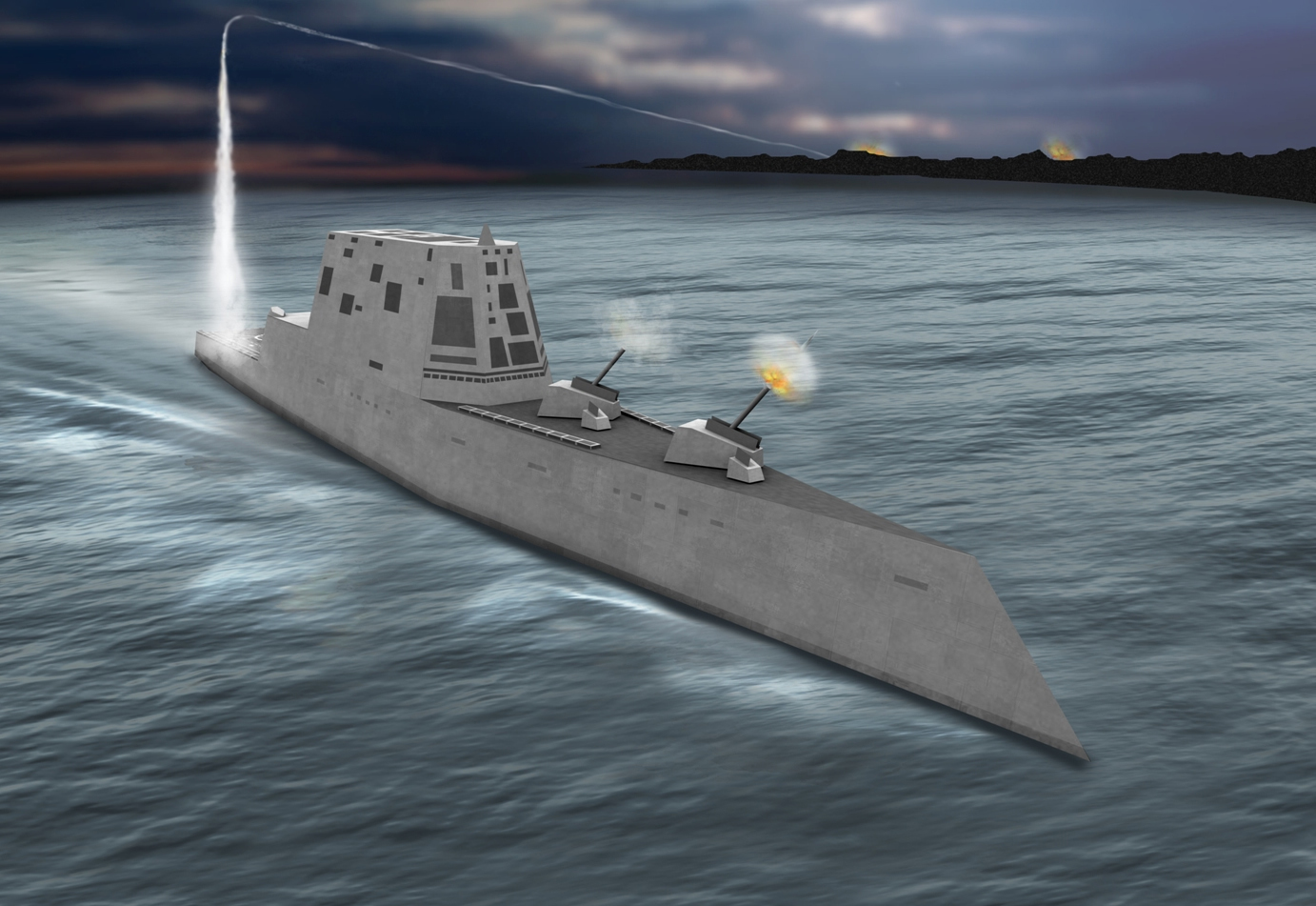
An illustration by the US Navy
The military do not often feature in this newsletter, so here’s a painting of the USS Michael Monsoor, the second of the Zumwalt class of destroyer.
One can only admire the attitude of the Americans who do not appear to be stopped from fulfilling their vision by anything. And in the Zumwalt class we have an example of that approach.
This ship is designed to be more or less invisible to radar, and has a wave piercing bow making it look more like a submarine on the surface than a surface ship. It is 600 feet long and has a couple of very unusual guns which can fire shells capable of being guided to the target. They also have numerous missile slots, and carry a helicopter.
Originally this ship was to be the second of about 30, but gradually the costs of building one have risen, from 1.4 billion dollars, to now about 4 billion. And consequently the numbers to be built have reduced, and now they are down to three.
The first is the one naming the class the USS Zumwalt, named after Admiral Elmo Zumwalt, famous in US Navy circles as being the youngest Chief of Naval Operations. He died in 2000. It seems that the USS Zumwalt is going to the combat ready in 2016.
The advanced gun system to be fitted to the ship has been developed by BAE Systems. It has a maximum range of 83 nautical miles using what are described as “Long Range Land Attack Projectiles”. It can fire a complete 300 shell magazine at 10 rounds a minute, using a water cooled barrel.
There continue to be controversies over the seaworthiness of the vessel, with some naval architects suggesting that because of the bow design it will become unstable in following seas and roll over.
VIEWS ABOUT THE EL FARO TRAGEDY

One of the photos of the El Faro on the Internet.
Early in October the American ro-ro and container ship El Faro was lost with all hands in the middle of hurricane Joaquin north of the quadrant of small islands which form the outer northeastern boundary of the West Indies. On that day the marine community in America must have been shocked beyond words, but now as the dust begins to settle and the NTSB investigation gets under way, and the law suits are beginning to be presented, maybe we can discuss what happened and what we might think about this tragedy, in which the whole crew of 28 and five Polish workers died.
I was drawn to an article written by a Mario Vittone on gCaptain a few days after the event. which postulated that an investigation was really unnecessary and that we know already what went wrong and why, and that even if the investigation finds things out and makes recommendations none of that will make any difference.
To quote his article “Phil Green of Tote Maritime (the owners) made the further assertion that the ship losing power is what ultimately led to the tragedy. This was more evidence of a culture of flawed risk management at Tote. Ships lose power all the time; they don’t sink because of it. Losing power is a possibility that ship owners and operators are supposed to have a written plan for. In fact it’s the law.” What he might have implied is that if a ship loses power it should be able to survive in any weather.
Well, here’s a thought. In UK the Health and Safety Executive believe that it is necessary for employers to provide procedures and systems which would keep people safe in all “reasonably foreseeable” events. And they believe that for an event to be reasonably foreseeable a man or woman in the street should see it as being a possibility. Hence using these terms it is indeed reasonably foreseeable that when a ship loses power in extreme weather it will eventually capsize, and that it would be unlikely that any of the crew would survive. After all, by now, many people will be aware that large modern and well found passenger ships have lost power in the vicinity of the coast of America and have had to be towed into port, but
one cannot imagine the chaos which would have resulted had the weather been anything other than completely calm.
Practically what might have been the progress of this disaster and how did the loss of power have an effect? Those of us who have been out in the North Atlantic could probably come up with the scenario. It appears from the maps of the hurricane that it moved southwest before turning back out into the Atlantic which might be why the El Faro met it. But beyond that, in extremely rough seas shipmasters who are not on a liner run, i.e. being forced to maintain a schedule due to commercial considerations, may reduce speed and head into the sea.
On loss of power nearly all ships will naturally turn beam on and start to roll violently, and if cargo is not sufficiently secured to withstand the rolling it will start to shift. Ro-ros are particularly prone to shifts of cargo because of the difficulty of securing vehicles on the cargo deck. So once the cargo has shifted and the ship takes on a list it becomes more prone to the ingress of water, which is what apparently happened to the El Faro. The captain had spoken to the DPA and described the ship’s condition as having a fifteen degree list that there had been ingress of water.
The NTSB have already determined that it was a company instruction that cargo should be “double lashed” and that this was apparently done. But if we were to question both the instruction and the fulfilment of it, the first thing to ask is how strong are the lashing points on a trailer, and how good are the securing points on the deck of a 40 year old ship.
But in any case, to avoid having to test the lashings it is prudent in adverse weather to minimise the lateral forces on the cargo by heading into the sea, or actually running before it under some circumstances. Hence it is important to keep the engine, or engines going in heavy seas, but even this depends on the type of ship and the type of cargo being carried if any. In my own experience I spent some years as a junior officer on small (by today’s standards) bulk carriers, mainly trading between Uk and the West Indies and North America. The ships routinely experienced extreme weather, particularly during the winter, and honestly it is difficult to imagine what have resulted if the engine, usually a large two stroke, had broken down. Even with the ships under control they were battered by the seas, and often suffered from the loss of unimportant bits of their superstructures. On one occasion I was a crew member on a ship running before mountainous seas north of the Azores, when behind us another ship suffered from structural failure and the crew evacuated in their lifeboats, after sending a distress message. Our captain evaluated the conditions and determined that if we had attempted to turn and retrace our steps towards the casualty the ship would have been seriously damaged. And so we just kept going.
The NTSB has also determined that the El Faro was in class with no deficiencies, but we can’t get away from it. It was 40 years old, and it is “reasonably foreseeable” that a 40 year old ship is more likely to succumb to the weather than a brand new one. Mariners on US nautical forums have suggested a similarity to the loss of the Marine Electric in 1983, which was then also 40 years old. More about Marine Electric next month.
THE SUPERYACHT A

This is the latest superyacht – maybe an inadequate description, built for the Russian billionaire Andrey Melnichenko. Perhaps it should be called an Ultra superyacht. It is the second vessel in his ownership to be called “A”.
It is moderately powered by two engines with a collective power of 7200 kW, and has secondary propulsion provided by a sail area of 4500 m2. It is 142 metres long and has a beam of 24 metres. Hence in the world with which I am most familiar it has the same dimensions as a medium sized pipe layer.
The cost of the ship is $400 million. It can accommodate 20 guests and has a crew of 54. It is said to be going to enter service in 2016.
According to some reports in the media the yacht features an underwater observation room. And doubtless in time pictures of the interior of yacht “A” will be released, as has happened with the current “A” also owned by the same billionaire, in time we will be able to view the luxury of the ship’s interior.
The design has caused something of an outcry amongst those who follow ship design, particularly yachts, which are often streamlined and elegant.