

THE LARGEST PASSENGER SHIP IN THE WORLD
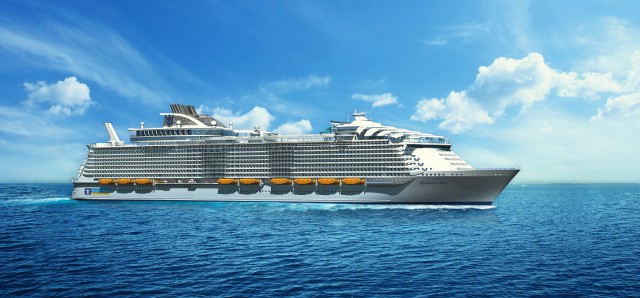
An Artist's Impression of the Harmony of the Seas. Picture: Royal Caribbean.
I always search for good news, and this could be some. I was asked the other day, while making a presentation about the Costa Concordia, what the largest passenger ship in the world was, and did not have the answer, but now I do. At least we know that it will carry 5,479 passengers. It is an odd thing that these cruise ships seems to be endeavouring to be as close as possible to a small town on shore, and typically the Harmony of the Seas is to be provided with 12000 live plants.
And gone are the days when passengers whiled away their time on board by walking round the deck a number of times until they had covered a mile, and played deck quoits using the rope rings because the movement of the vessel prevented the playing of ball games. Today there are water slides, two on the Harmony of the Seas, climbing walls and The Rising Tide Bar, said to be a moving bar at sea covering three decks. And as for eating. We now have more than the first class and tourist restaurants, and actually I once sailed on a ship where some of the Chinese passengers cooked their own food on braziers on the after deck. No. Today there are themed restaurants all over the place, including on the Harmony of the Seas, something called “Dynamic Dining”, billed as a brand new way of eating. What could that be?
But there are some things I would like to know if I was considering a cruise, none of which they have chosen to tell us, like what systems the Emergency Generator operates, and whether the main engines’ power supplies are truly dual. Both of these questions as a result of cruise ship power failures in the Pacific where on one ship 3000 people were left without working lavatories for three days. And we would also like to know how effective the emergency procedures are likely to be. Actually how effective they could be, given the enormous size of the ship, the vast numbers of people and the fact that the designers are attempting to give the passengers the impression that they are not at sea at all, then suddenly when everything goes to hell, they realize they are in a hostile environment.
THE JONES ACT AND OTHER TOPICS
While researching for the main article on the next page I came across an exchange of views on the gcaptain forum. On the subject of DP qualifications there was a post from a guy, probably Russian who worked a ship which was doing stuff in the GoM. He had a Chief Mate’s quaification and DP approvals. He had also obtained a visa for travel to the ship, as all seamen have to do. The response to his post was violently abusive, telling him to get back home and get off the forum (But less politely). The American poster said that there were thousands of mariners in the US looking for jobs. But I ask you, what more could the American Regulators do? The Jones Act requires all ships travelling between two US ports to be built, registered and crewed in the US, and they have a whole raft of grading on their ships, which allow nearly anyone who wants to, to go to sea in some capacity. So to those posters, you should try it out there like the rest of us.
THE BARIS
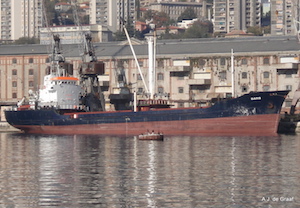
The Baris. Photo Shipspotting.
Some time in December the Baris was found drifting in the Mediterranean by the Greek Navy with more than 700 refugees on board, and according to the media more than 500 were women and children. This was probably the first of a number of incidents which involve quite substantial vessels abandoned by the crews with refugees on board.
I thought that maybe the flag state would have some responsibility for the vessels registered in its territory and so I had a look at where it was registered – Kiribati!
We are fortunate in having instant research facilities available so I was quickly able to determine that Kiribati is a group of atolls in the middle of the Pacific, which we old Brits might know better as the Gilbert part of the Gilbert and Ellis Islands.
I have a lot of affection for the Gilbert and Ellis Islanders having worked with a deck crew from there back in the 1970s in the Emirates oilfields. They were wonderful seamen, and it was great to have them as part of the team on a ship doing quite a difficult job. In addition to their professional competence when I saw a shoal of what we knew as “King Mackerel” passing I would ask them to get their fishing poles out, and in about ten minutes they would catch enough fish for tea for all thirty of us on board.
However, that being said I have serious doubts that the islands have the resources to operate a ship registry, and hence to determine where and how this ship ended up as a drifting hulk full of people who should not have been there. This is yet another case of a register just taking the money rather than accepting responsibility for its registered vessels.
A DP INCIDENT IN THE GULF OF MEXICO
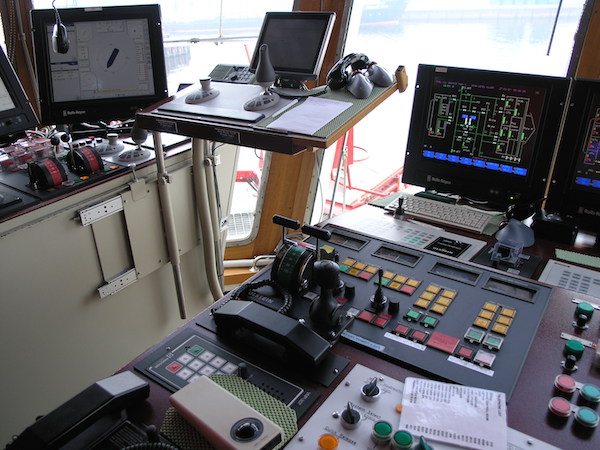
A DP1 System on an Offshore Vessel. Photo Victor Gibson
Just a few days ago the BSEE (The Bureau of Safety and Environmental Enforcement) made a joint safety alert with the US Coast Guard concerning an incident on the US outer continental shelf where a vessel engaged in well related operations suffered a critical loss of position. The safety alert says that “the vessel operator was in the process of removing a downhole DX plug from the well via wireline, and that high pressure pump lines were also connected to the “christmas tree”. The alert does not choose to explain what the activity was that was being undertaken, and a search on Google for an explanation of this item only resulted in further media reports of the same incident, all of them mentioning the DX plug, but none of them saying what it was. So firstly we should take a guess at what a DX plug is, and it seems to be a component which can be inserted or removed from the well by wireline and has a purpose somewhere within the activities which relate to high pressure pumping, which could be used to restore a well to proper operation.
Unfortunately the safety alert says nothing about the ship, other than it was a DP1 vessel and did not have, nor was required to have, any documentation relating to the ISM Code. So firstly let’s make some guesses about the ship and its operations. It seems likely that it was engaged in some form of well stimulation at a platform, so probably in fairly shallow water. Maybe a mast was set up on the deck of the platform and the wireline was led back to the deck of the ship, allowing plugs to be set or unset. And at appropriate moments high pressure fluids could be pumped down the well, via connections on the what the report is described as the “christmas tree”. In the oil business this is a manifold installed at the top of the well pipework, providing a number of valves, flowpaths and connection which allow for the recovery of well fluids and the means of well stimulation – the activity in which the ship was probably engaged.
This was probably quite a large vessel, maybe a former platform ship with its deck covered in well stimulation equipment which would include large tanks of noxious liquids and high pressure pumps and the wireline equipment which was in use. At the stern would be the hose reels which would allow the well to be connected to the pumping system. It would have been assumed by the ship-owner that the engines, propulsion and controls were adequate for the task, and so there would have been limited, or no, upgrade to the machinery and control systems.
While the well stimulation was being controlled from some sort of shack on the deck of the ship, up in the Pilot House someone would be monitoring the DP system to make sure it was keeping the ship in position while the work was being done. But during the wireline operations there were a number of alarms relating to DP system, including loss of “bowthruster and engine control”. But no attempt was made to identify or correct the causes of these failures, which seems almost impossible to believe. So one assumes that the ship was subject to spurious alarms, or else that no-one was actually taking any notice of what was happening.
What happened next was that the ship drifted off station and the high pressure hoses pulled the manifold off the top of the well pipework, but by then the safety valve down hole had been set, so obviously the guy in the shack on the deck knew what he was up to, so there was no pollution.
On the website ‘gcaptain’ a picture of the manual controls of a semi-submersible have been used to illustrate the article which is just a bit unhelpful. But why was a ship which was being used for well intervention not required to conform to the ISM requirements? Then it came to me, that in the US Gulf some ship owners ensure that their ships measure less than 500 gross tons, and that therefore they do not have to conform with the International Maritime Organization (IMO) requirements. Indeed some quite large ships in the Gulf measure less that 200 gross tons. They do this because the smaller the ship in terms of gross tonnage measurement, the less comprehensive the marine qualifications needed to operate it. Also vessels under 500 gross tons are virtually exempt from IMO regulations. Hence the lack of ISM Code documentation. Of course not being required to have a safety management system does not mean you should not have one. And the lately initiated SEMS Regulations in the Gulf of Mexico, the Safety and Environment Management System, requires that oil companies have a safety management system in place which has to be audited by independent auditors at specified intervals, but at present SEMS does not apply to mobile units or ships. However, the safety alert goes on to suggest that possibly if the ship had been provided with a safety management system it would have had emergency disconnect procedures, and people trained in the process.
It also suggests that maybe a DPII ship would have been better suited to the task, and for those who might not be quite up to speed on the DP classes, a Class I vessel is one which would suffer loss of position if there was a single system failure, a Class II vessel is one which would not suffer loss of position in the same circumstances.
To many it would seem foolhardy in the extreme to be carrrying out this sort of work with a DP1 vessel, particularly after all the pain and suffering which has resulted from the Deepwater Horizon disaster. But there are moves afoot to change all that since there is apparently a document doing the rounds in the USA which proposes changes to the rules for well intervention.
And though I am cautious in mentioning it, in the UK a well intervention ship has to have a safety case, and while the safety case is not the silver bullet some people thought it was going to be, at the very least some sort of risk assessments have been carried out to minimise the risks resulting from well related activities. (Please bear in mind that what is written here is mostly guesswork)
THE PIONEERING SPIRIT
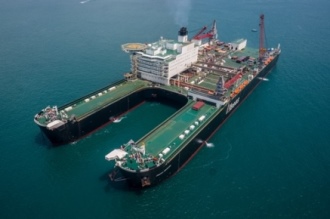
Pioneering Spirit from Allseas Publicity.
When Shell announced the chartering of the Pieter Schelte to carry out decommissioning work in the Brent Field the British unions protested, mainly because of the association of the name with that of a man who had been a member of the Gestapo during the Second World War.
In early February Allseas published a letter from its Chief Executive, which stated that while he expressly dissociated himself from his father’s activities during the Second World War. The ship had been so named for the following reasons:
Pieter Schelte Heerema, born in 1908, moved to The Netherlands and entered the North Sea with a crane ship for oil platform installation. He developed his company further until his death in 1981. By that time he had built several technically innovative crane vessels and became known as the pioneer of the offshore construction industry.…
The technical creativity and entrepreneurship of Pieter Shelte Heerema were an example for his son Edward (born 1947). This example laid the foundation for Allseas, the company which Edward formed in 1985, three years after his father’s death. The building of the single-lift ship “Pieter Schelte” marks a technical breakthrough in installation and clean and safe removal of oil platforms world-wide. It is precisely Edward’s acknowledgement of his father’s creativity and entrepreneur-ship that led to the choice of the name of the ship.
The name was changed on February 9th 2015.