

Running Aground
Some years ago I wrote a short story which won a prize. Not the easiest thing to do in a world which seems to be full of creative writers. And I thought I might include it here as a sort of Christmas gift for my readers, who still visit the site. So have a great Christmas and enjoy the story.
Before he got to the bridge the captain could smell the heat of the Indian morning. The odour was a mixture of dried wood, tar, diesel oil and very faintly overlaying it all, the musky smell of tropical blossoms. Closer to the land the smell might be obscured by the overwhelming stench of a million people living in close proximity to each other.
My moment of fame has come and gone, as I was featured in an article in the Daily Mirror, but nevertheless I quite liked it. Although the article said that I was in favour of continued oil production in the Uk sector of the North Sea, I also said that it was in decline anyway. Anyway here it is. You might have to do some scrolling if you want to read it.


One assumes that after the Ulstein organisation had sold the UT designs to Rolls-Royce they had pledged not to produce any further offshore vessels for a period. This is usually five years, but in 2002 they were back with a bang. Four anchor-handlers rolled off the stocks at Ulsteinvik, the Normand Mariner, the Normand Master, the Olympic Hercules and the Olympic Pegasus. The very first was the Olympic Hercules (Photographed by the author in Bressay Sound in 2007) which was named at Ulsteinvik on 12th January 2002. They were designated the Ulstein A101 and don’t forget the “Ulstein” they said. It is difficult to put a finger on it, but it could be that the “100” part of the “101” could be a celebration of the 100th year of the yard’s existence. The Ulstein A101’s Wartsila engines developed 23,330 bhp giving them a bollard pull of 280 tons. Their thrusters gave them plenty of sideways power and to keep everything under control they were provided with DP2. These were ships which seemed to have no limitations. They had what seemed to be unlimited power they could be fitted with an A-frame and they had enormous winches and storage drums, so that they were useful for the increasingly frequent task of inserting fibre rope into the moorings of semi-submersibles which were working at the extremes of their capabilities or else where the moorings were to pass over pipelines. In the first decade of the new century fibre rope was the new material for securing rigs to the seabed. The advantage was that it was buoyant and so could be of unlimited length in the mooring, but the disadvantage was that it was of extremely large diameter. When required to insert chain into moorings the captains of the A101s would be likely to put the ship into DP and then pay out the new chain onto the seabed, and when that was done run it out on the correct bearing. Importantly for charterers, the bridges were extremely well appointed and I always felt that they gained some charters on the basis of how good the oil company representatives felt when they were sitting on the leather sofas at the edges of the wheelhouse (The luxurious bridge of the Hercules photographed in 2002). Their reliability has resulted in the four ships being almost continuously at work throughout their lives and the most recent information I can find about what they are up to indicates that they are still busy, and still in their original ownership. During 2016 the Hercules and the Pegasuswent off to West Africa with others of the Olympic fleet and at the same time the Normand Mariner went to work on an extended contract for Technip.

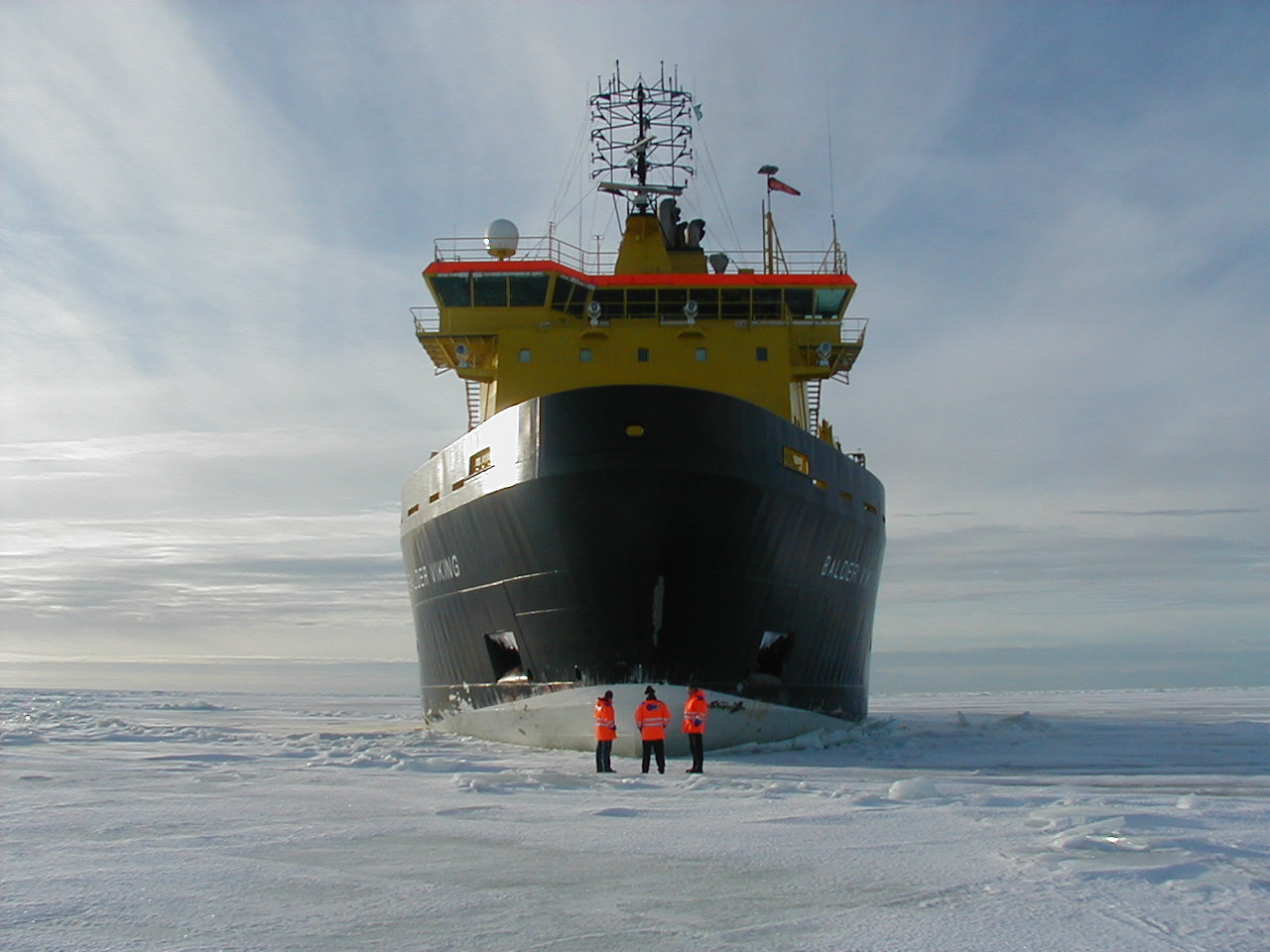
Back in the 1970s a Norwegian company known more for its colour scheme than anything else was Viking Supply Ships, whose craft were painted in black and yellow diagonal stripes. One, the Edith Viking featured on the first rig shift I ever went on in about 1977 and I was struck by its paint job. Later another of the company ships, the Ben Viking, was hired by a film company to take part in the movie “North Sea Hijack” which featured, in addition to the delightfully painted ship, the British actor Roger Moore (who died last Tuesday). If this was a film blog I would say more. Like many OSV companies Viking have had their ups and downs and in their lifetime have had other names, and for a while we thought that the striped ships were toast, so we were cheered when the Tor Viking II and the Balder Viking (Photographed in the ice by Bart Trondsen in 2004) arrived in Aberdeen in 2000. They were KMAR 808s, and only recently I reviewed the KMAR 404 probably as different from the 808 as chalk from cheese. They were designed in the marine architects house owned by Kvaerner, which had been Maritime Engineering and actually was to become Moss Maritime…but more of that company later. The first two 808s were followed in 2001 by the Vidar Viking. They were all constructed at Kvearner Leirvik and were intended to double as commercial anchor-handlers during the summer, and if requested, as Baltic ice-breakers during the winter, and in their icebreaker role they would be fitted with a V shaped extension at the stern, and a helideck in the middle of the main deck. The V shape would enable them to pull commercial vessels close up to their sterns, and then they would steam ahead breaking the ice and dragging the cargo ship behind them. As anchor-handlers they were provided with four MAK engines providing them with 18,300 bhp and 200 tons bollard pull and for the purposes of keeping them free of ice they were provided with pumping systems and wing tanks which could create a 10 degree list in 20 seconds. From the start they proved popular with operators and for all three to be together at any time proved to be a rare occurance (although captured on film by the author in Aberdeen in 2001). As well as working in the North Sea and the Baltic they have been out to Sakhalin and also to Alaska in support of potentially icebound exploration drilling. Today, in what might be described as an extremely competitive offshore environment they are still proving popular, the Tor Viking II and the Balder Viking currently being engaged in a North Sea rig shift, although the Vidar Viking is laid up, and may only be reactivated at the end of the year, one assumes in time to engage in icebreaking activities.


We might be wondering by now what Maersk have been up to since one of their vessels was last described in this feature, which was the Maersk Fighter which entered service in 1992. They had actually been building a number of anchor-handlers derived from the ME 303, designated the ME 606 and then the ME 909, mostly known as the Maersk B Class. These designs were to culminate in what was known as the Maersk A Class, starting with the Maersk Assister in 2000 (Photographed entering Aberdeen in 2001 by George Craigen). The class was larger and more powerful than anything Maersk had so far produced and were briefly the most powerful and probably the largest anchor-handlers afloat at 90 metres long; they contained nine decks between the main deck and the bridge but no elevator. The four MAK engines produced 23,500 bhp, giving them a bollard pull of 278 tons and the multiple forward and aft thrusters were capable of providing 6000 bhp sideways. All these systems could be controlled by a DP2 system provided by Kongsberg. The winch which was electrically powered, a Maersk innovation while everyone else was still putting their faith in low pressure hydraulics, was capable of a pull of 625 tons, leading the manufacturers of fabricated anchors to issue guidance as to how much force should be used to get them over the roller, this after the ships had bent a few. In addition, when they came out, a workdrum capacity of 12000m x 84mm wire, and a capacity of 2600m x 84mm wire, was claimed for each of the two tow drums, although I have noticed that ship-owners are tending not to tell us about drum capacity these days. However, I have been on board the Maersk Assister and can confirm that the winch is very large indeed. In typical Maersk style the whole thing is housed in a great big hanger and is viewed from the bridge on CCTV. The problems of paying out the wires under tension, which had made previous attempts to power winches electrically impractical, has apparently been overcome by using electrical resistance and dissipating the heat through vents on either side of the winch space. The Assister was followed into service by the Maersk Achiever, the Maersk Asserter and the Maersk Advancer in 2003 and the Maersk Winner in 2004, all of them being constructed at the Volkswerft yard in Germany. In order to make them suitable for multiple activities the ships have accommodation for 60 people and several have subsequently fitted with large cranes for the field maintenance activities. The Winner in particular was fitted with a 200 tonne crane capable of working at depths of 2000 metres when it entered service and has accommmodation for 86 people.
