
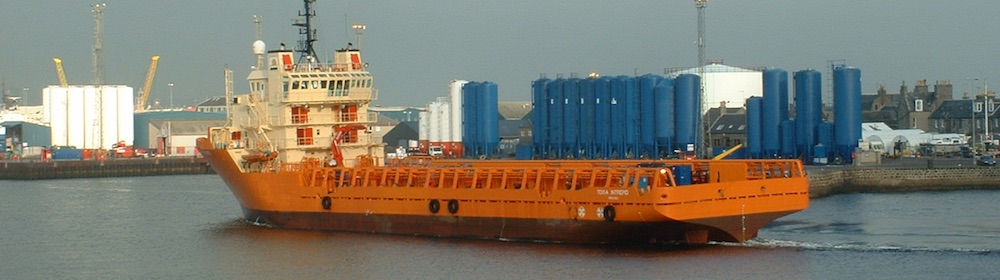

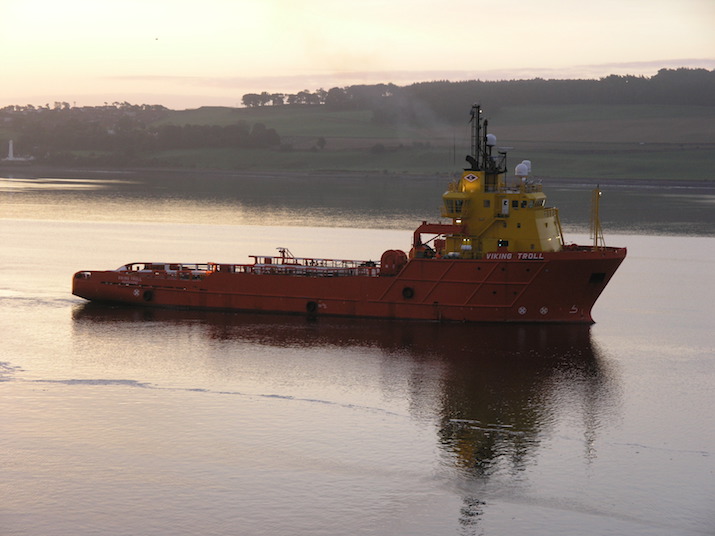
Photo of the Viking Troll, once the Stirling Iona.
Back in the 1970s in what some might remember as being the heyday of British supply vessel ownership, virtually every ship to enter service was an anchor-handler. The fleets operated by Offshore Marine, Seaforth Maritime and Ocean Inchcape consisted of vessels with a winch at the forward end of the Main deck and a roller at the stern. The British considered themselves to be one step ahead of the Americans whose vessels still had bolt on diesel powered winches. Most of the Offshore Marine vessels were built by Appledore Shipbuilders at their North Devon yard and most of the Seaforth ships were built by Drypool Engineering at Selby, launched sideways into the River Ouse and then eased down into the Humber. The only company to wholeheartedly embrace the concept of the platform supply vessel was Stirling Shipping who operated a number of small platform ships, built to their own design
When the UT704 arrived it seemed unlikely that a British yard would ever built another offshore support vessel because it, and the Norwegian designs which followed could outperform everything else available. Today Norwegian designs still dominate the market, but British yards are building supply vessels again, and it is something of an achievement that Hull No 707 from Fergusons Shipbuilders Ltd is an anchor-handler, the first to be built in the UK for over 20 years.
Hull 707 is now known as the Stirling Iona, designated a Stirling VS473, is a design which has resulted from co-operation between the Norwegian designers Vik & Sandvik and the Stirling Shipping Company.
The Stirling Iona is a sensible ship in a world populated by exotica, and it is possibly a move back towards those basic requirements which motivated the British shipowners in the 1970s. They wanted to provide ships which would carry out all the taks which might be required of them by the fledgling North Sea oil industry. And since most of the objects out there were floating, anchor handling and towing was the first requirement followed by an ever increasing supply capability.
The progress of the floating objects out into the deeps has encouraged numerous shipowners to built larger and more powerful vessels with the capacity to store thousands of meters of large diameter wire on their work drums; or in some cases sufficient rope to tie said objects to the seabed with a variety of unusual anchors. However there is still a need for medium sized ships capable of moving semi-submersibles from one point to another in water depths of less than 700 meters and capable of towing and supplying both semi-submersibles and jack-ups in areas less well served with marine support than the Shetland Basin. Presumably this the market that the Stirling Iona is intended to serve, and even though the winch appears to take up little space on the deck, the work drums are sized for 1390 meters of 76mm wire.
In a style which reflects the earliest anchor-handlers the winch is completely exposed, allowing those at the controls of the ship and the winch to see exactly what is happening down there.
Instead of being provided with accommodation for 24 spare bodies which seems to have become the norm for the larger AHTS, the Iona has berths for 16 people, thereby ensuring that it does not become embroiled in peripheral activities such as surveying or ROV work, however instead of having the little used 6 berth cabins there are a couple of spacious store rooms on the main deck.
Although the VS473 first appeared in about 1983 this ship is only a little like the original. The design benefits from the developments in engines, and the prime movers are shoe-horned in under the accommodation with long shafts to the gearboxes and the screws. In what seems to be accepted as the British approach, mud and brine tanks are ranged down either side of the underdeck space aft of the engine room - designed to avoid internal framing, and the dry bulk tanks are set down the centre. Fuel and water are mainly contained with the hull and the forward and aft tanks.
| TYPE: VS 473 AHTS | NAME: Viking Troll | PHOTO: Vic Gibson, Jan Plug | |||
 |
 |
.JPG) |
|||
|
GENERAL |
PROPULSION |
EQUIPMENT |
|||
| Length OA | 73.9 m | Engines | 2 x Wartsila 12V32 | Workdrum pull | 300 tonnes |
| Breadth | 16.0 m | BHP | 15000 | Capacity 1 | 1390m x 76mm |
| DWT | 2881 t | kW | 11030 | Capacity 2 | 1390m x 76mm |
| Deck area | 550 m2 |
For'd Thruster |
2 x 816 bhp | Towdrum pull | 300 tonnes |
| Fuel | 779 m3 | Az Thruster | Capacity 1 | 1560 x 76mm | |
| Pot water | 616 m3 | Aft Thrusters | 1 x 816 bhp | Capacity 2 | |
| Mud | 427 m3 | Bollard pull | 158 t | Sharks Jaw | 2 x Karmfork |
| Brine | 534 m3 | DP | Cranes | ||
| Dry bulk | 135 m3 | Joystick | Kongsberg SJ01 | Tank cleaning | |
| Year built/due | 2000 | Shipyard | Fergusons | ||
| Previous names | Stirling Iona, Havila Force | ||||